
About this project

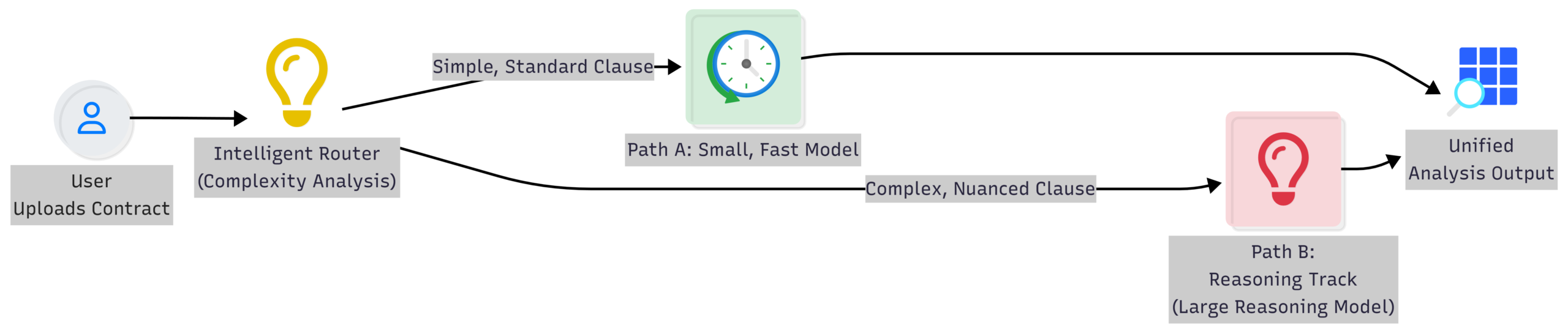
Legal AI tasks are not one-size-fits-all. Extracting clauses from contracts requires different model capabilities than interpreting legal obligations or assessing compliance risks. LAMMR (Legal Adaptive Multi-Model Router) addresses this by dynamically routing each task to the most suitable language model, combining rule-based logic with a learned predictor. Every routing decision is logged and auditable – a requirement in legal deployments where transparency and reliability are non-negotiable. A task-aware evaluation layer scores extraction and reasoning outputs separately, preventing performance in one area from masking failures in the other. The system was validated on over 1,000 legal tasks and demonstrates significant improvements over single-model deployment. Accepted at HHAI 2026 (5th International Conference on Hybrid Human-Artificial Intelligence), Brussels, July 6–10, 2026.
Discover the team behind this project


Aditya Mukhopadhyay
Aditya MukhopadhyayAI Intern - NLP
Bioinformatics – Data Science – Data Analytics – Computer Vision – Deepfake Detection


Published On: 26 January 2026Categories:

Related projects

  • This project studies the robustness of country-wide railway networks using network science methods. The networks are built from GTFS data and modeled as graphs capturing stations and rail connections. Network efficiency and connectivity are tracked as stations are progressively removed under different disruption strategies to assess the impact on overall system performance.

  • EnergyAgent is an LLM-powered conversational assistant for household energy monitoring and efficiency. It enables natural-language queries over smart-meter data and provides strictly factual responses derived from recorded consumption. User questions are translated into explicit calculation steps processed by an analytics engine, ensuring numerical accuracy. The system then converts these results into clear, actionable insights to help users better understand and optimize their energy usage.

  • This project leverages Physics-Informed Neural Networks (PINNs) to model and forecast the thermal performance of power transformers in the Belgian transmission network. By combining physical thermal equations with historical operational and environmental data, the approach enables accurate temperature estimation, early detection of overheating risks, and supports data-driven predictive maintenance strategies.

  • The project explores how AI models may prioritize certain information over others in corporate scenarios. From favoring recent data to reinforcing specific perspectives, we analyze these biases to promote more transparent and fair AI systems. Our partners are DTSC and UAntwerpen

  • This project studies the robustness of country-wide railway networks using network science methods. The networks are built from GTFS data and modeled as graphs capturing stations and rail connections. Network efficiency and connectivity are tracked as stations are progressively removed under different disruption strategies to assess the impact on overall system performance.

  • EnergyAgent is an LLM-powered conversational assistant for household energy monitoring and efficiency. It enables natural-language queries over smart-meter data and provides strictly factual responses derived from recorded consumption. User questions are translated into explicit calculation steps processed by an analytics engine, ensuring numerical accuracy. The system then converts these results into clear, actionable insights to help users better understand and optimize their energy usage.